Every darts player has owned a set of flights where the design started lifting at the corner. You pick at it once, tell yourself you will leave it alone, and two weeks later the whole thing is peeling back like an old sticker. Here is why that happens, and why engraving does not have the same problem.
A printed flight is two materials pretending to be one
Printing adds something. Ink, or a printed film, sits on top of the polycarbonate. However well it is applied, it is a separate layer bonded to a surface, and that bond is the weak point.
Three things attack it, constantly:
- Abrasion in the case. Flights rub against each other and against the case every time it is carried. That is thousands of small scuffs over a season.
- Extraction from the board. Every time you pull a dart out, your fingers grip near the flight. Skin oil, sweat and pressure all work at the printed edge.
- Deflection. A dart bouncing off a wire hits its neighbour’s flight hard. That impact lands directly on the printed surface.
None of that is a manufacturing fault. It is simply what happens when you put a coating on something and then use it.
Engraving removes material instead of adding it
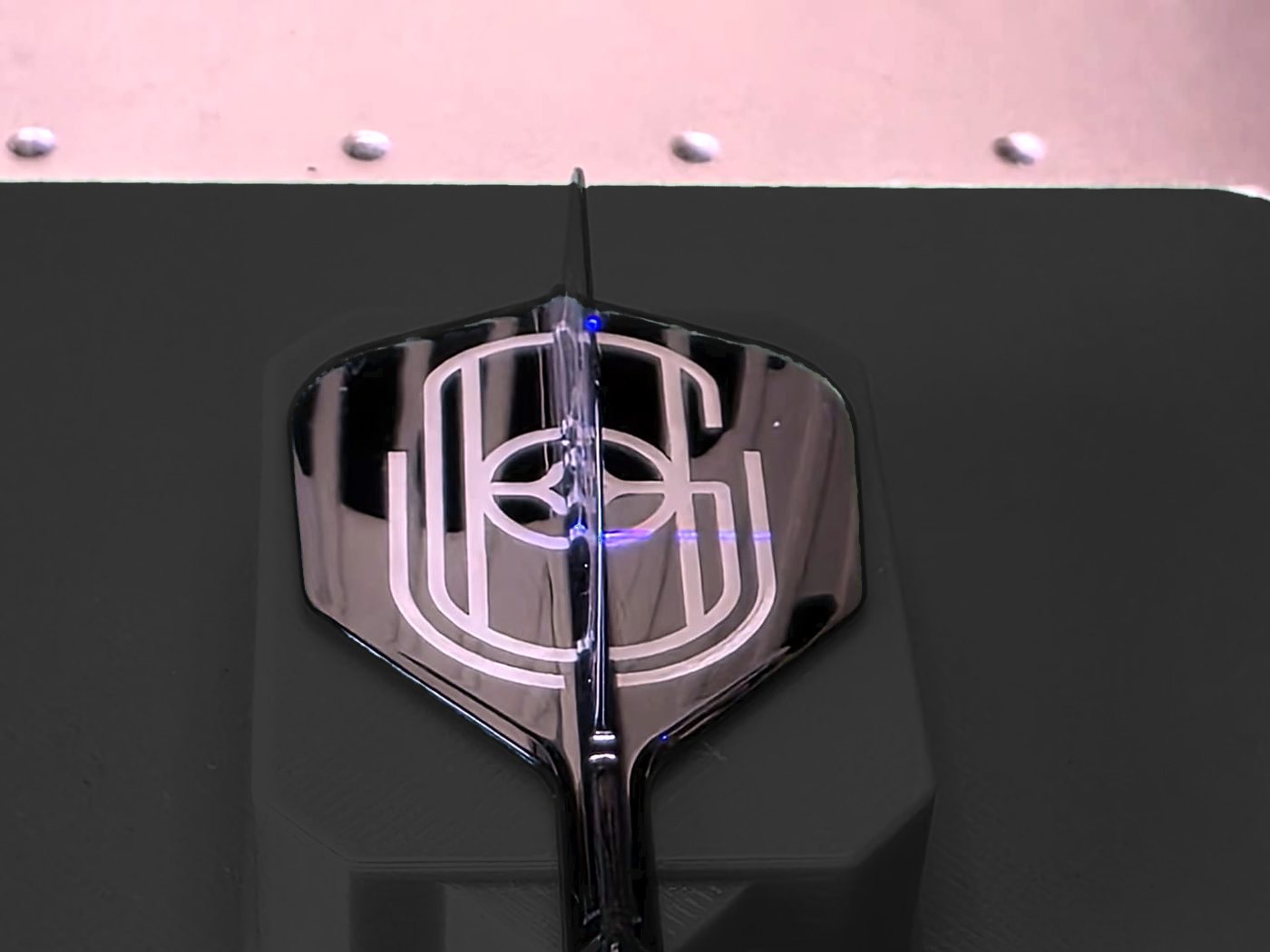
Laser engraving works the other way round. Rather than laying something on the surface, the laser removes a controlled amount of it. The design is cut into the flight. There is no separate layer, no bond, and therefore nothing that can lift, peel or wash off.
Scuff an engraved flight and you are scuffing the flight. The design is not sitting on top waiting to come away, because it was never applied in the first place. It is part of the same piece of plastic.
The honest limitation
Engraving is not better at everything, and it is worth being straight about where it loses.
The engraving reads as white, because you are exposing the material rather than adding a colour. That means it needs a solid background behind it to be visible. Solid black works beautifully. Solid colours work. Transparent flights do not work at all, because there is nothing for white to read against. That is the one thing we turn down.
Printing also wins on full colour. If you want a four-colour photographic design, printing is the process that does that. Engraving gives you one colour, cleanly, permanently.
What this means in practice
If you want something that looks bright and complicated on day one, printing has its place. If you want your name, your nickname or your club crest to look exactly the same on the last night of the season as it did on the first, engraving is the process that gets you there.
For a pub team especially, that consistency matters. A side that starts the season with matching flights and finishes it with eight sets in eight different states of wear does not look like a side any more.